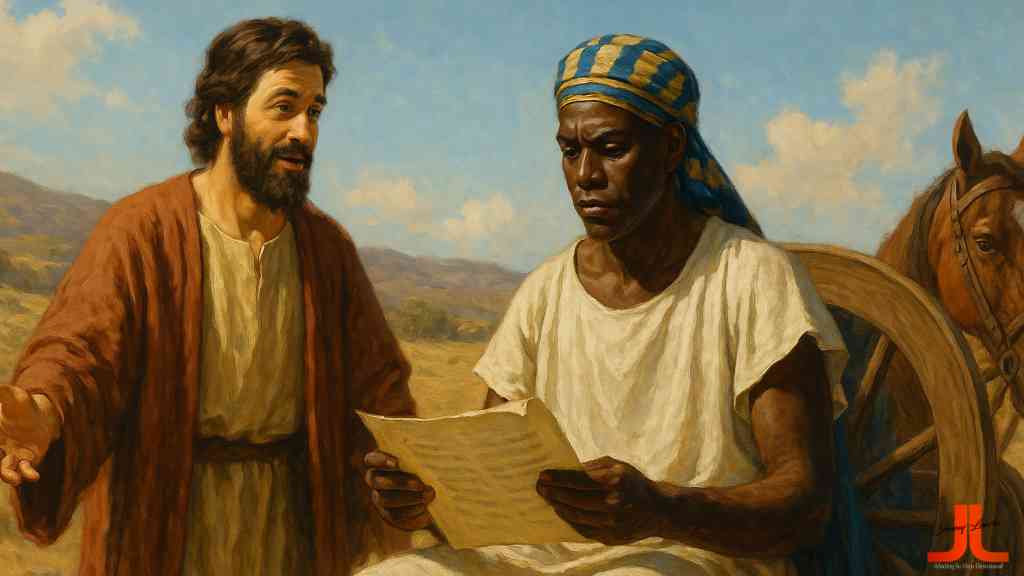
Who Was Apollos?
Apollos (short for Apollonius) first appears in Acts 18:24–28, where Luke gives a concise but impressive description:
“Now a Jew named Apollos, a native of Alexandria, came to Ephesus. He was an eloquent man, competent in the Scriptures. He had been instructed in the way of the Lord; and being fervent in spirit, he spoke and taught accurately the things concerning Jesus, though he knew only the baptism of John.” (Acts 18:24–25)
From this, we learn several key things:
- He was Jewish — but also highly educated, likely influenced by both Hebrew Scripture and Hellenistic culture.
- He was from Alexandria, Egypt — one of the greatest intellectual centers of the ancient world, home to the famous library and a large Jewish population known for scholarship and philosophy.
- He was eloquent and learned — skilled in rhetoric and well-versed in the Old Testament.
- He knew the message of John the Baptist — repentance and preparation for the Messiah — but initially lacked full understanding of the gospel and the Holy Spirit.
How Apollos Became a Gospel Preacher
When Apollos arrived in Ephesus, he began teaching boldly in the synagogue. There, Priscilla and Aquila (Paul’s trusted co-workers) heard him and “took him aside and explained to him the way of God more accurately” (Acts 18:26).
After this discipleship moment, Apollos’ ministry exploded with clarity and power. He went on to Achaia (specifically Corinth), where he “greatly helped those who through grace had believed” (Acts 18:27–28).
Apollos became a gifted preacher and teacher who powerfully defended the gospel, showing from Scripture that Jesus is the Messiah. His ministry in Corinth was fruitful and influential — so much so that his name later became a banner for one of the church’s factions.
Why Paul Brings Up Apollos in Corinthians
1. Division in the Church
In 1 Corinthians 1:12, Paul identifies a major issue:
“Each one of you says, ‘I follow Paul,’ or ‘I follow Apollos,’ or ‘I follow Cephas,’ or ‘I follow Christ.’”
The Corinthian believers, enamored by charisma and eloquence, began aligning themselves with different teachers.
- Some admired Paul’s missionary zeal and authority.
- Others preferred Apollos’ eloquent, intellectual preaching style — likely appealing to the Greek love of rhetoric.
- These preferences turned into divisive loyalties that fractured the church.
Paul mentions Apollos not to oppose him, but to correct the people’s prideful attitudes. He and Apollos were not rivals — they were co-laborers for the same gospel.
“I planted, Apollos watered, but God gave the growth.” (1 Corinthians 3:6)
Paul uses this image to remind them that ministers are instruments — God is the source of life and fruit.
Apollos’ name thus becomes a case study in misplaced devotion: the Corinthians were elevating human teachers instead of honoring the Lord who works through them.
2. A Model of Unity in Ministry
Interestingly, Paul continues to speak warmly of Apollos:
- In 1 Corinthians 16:12, Paul writes: “Now concerning our brother Apollos, I strongly urged him to visit you with the other brothers, but it was not at all his will to come now. He will come when he has opportunity.”
This shows mutual respect — not competition. - In Titus 3:13, Paul even instructs Titus to “help Zenas the lawyer and Apollos on their way,” implying Apollos remained an active, trusted missionary leader.
So while the Corinthians tried to pit Paul and Apollos against each other, Paul himself viewed Apollos as a fellow worker under the same Lord.
Spiritual and Historical Insight
- Apollos represents the gifted, articulate teacher — brilliant and persuasive, yet humble enough to be corrected and trained.
- Paul represents the foundational apostle — bold and pioneering, laying the groundwork for others to build on.
Together they demonstrate that ministry diversity is not rivalry, and eloquence is not the same as spiritual power.
The Corinthians’ error was idolizing personalities instead of glorifying God. Paul’s repeated references to Apollos serve to heal that division and remind the church that every servant of Christ is part of one mission — planting, watering, and trusting God for growth.
Summary
- Apollos: a well-educated, eloquent Jewish teacher from Alexandria, Egypt.
- Taught by Priscilla and Aquila, became a powerful gospel preacher.
- Served in Corinth, where his eloquence impressed believers.
- Paul mentions him repeatedly because the Corinthians turned admiration into factionalism — saying, “I follow Apollos.”
- Paul responds by affirming unity: “He who plants and he who waters are one.”
In short: Apollos was not Paul’s rival but his partner — a gifted preacher whose ministry the Corinthians misunderstood. Paul mentions him repeatedly not to critique him, but to correct the church’s pride, reminding them that the focus of faith must always be on Christ, not the messenger.